
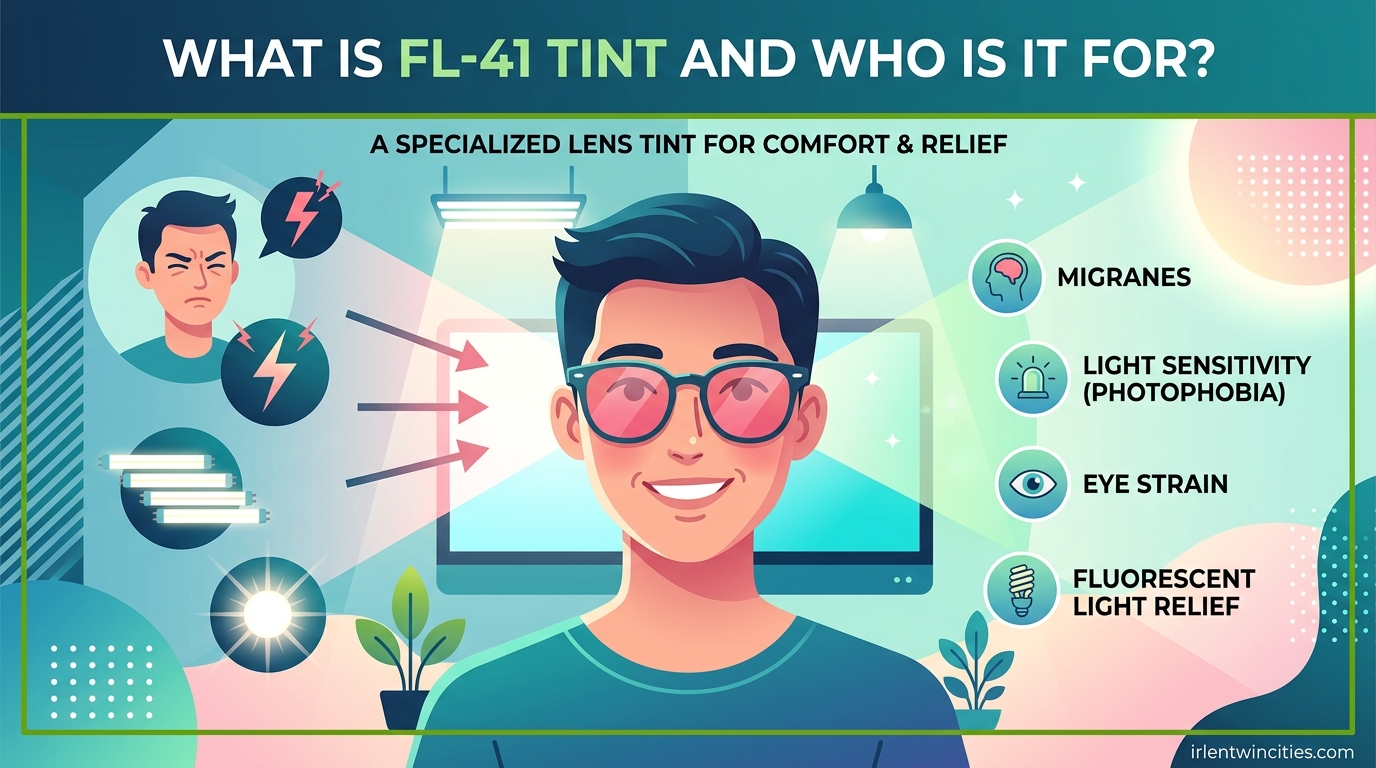
FL-41 tint is a specialized rose-colored lens coating designed to filter out specific wavelengths of light — primarily in the blue-green spectrum around 480 to 520 nanometers — that are known to trigger migraine episodes and exacerbate light sensitivity. Unlike standard tinted lenses, FL-41 is precision-applied using thin-film optical coating technology, allowing it to selectively block the light frequencies that cause discomfort while permitting other wavelengths to pass through relatively undisturbed. This makes FL-41 distinct from ordinary sunglasses, which simply darken the visual field without offering targeted relief for photosensitive conditions.
The tint takes its name from the Fluorescent 41 designation given by its original developer, Dr. James W. Wilkins, an optometrist who began researching light-filtering lenses in the 1980s at the Southern College of Optometry. Dr. Wilkins observed that certain patients with migraine and photosensitivity responded remarkably well to specially tinted lenses — particularly when the tint reduced exposure to flickering fluorescent light frequencies. Over subsequent decades, the formulation was refined into what is now recognized as the modern FL-41 standard, with ongoing research continuing to validate its effectiveness for a growing list of neurological and ocular conditions.
Table of Contents
How FL-41 Tint Works: The Science of Wavelength Blocking
To understand why FL-41 works, it helps to understand a bit about how light and your eyes interact. Light exists on a spectrum, measured in nanometers (nm), and different wavelengths correspond to different colors. Blue-green light, in the range of approximately 480 to 520 nm, has been identified in clinical research as particularly problematic for individuals with migraine and photophobia. This range overlaps significantly with the light emitted by fluorescent lighting, LED screens, and energy-efficient bulbs — the very sources of illumination that dominate modern indoor environments.
FL-41 tint works by applying a thin-film optical coating to the surface of a lens. This coating acts as a filter, selectively attenuating (reducing) light energy in the 480-520 nm range while allowing other wavelengths — including those needed for normal color perception and visual acuity — to pass through. The result is a lens that appears faintly rose or pinkish in color, reduces the intensity of harsh indoor lighting without making the world unbearably dark, and specifically targets the wavelengths most likely to trigger photosensitive symptoms.
What makes FL-41 particularly valuable is its indoor applicability. Because it does not excessively darken vision, it can be worn comfortably during computer work, under fluorescent office lighting, or while driving at night — situations where traditional sunglasses would be impractical or dangerous. The tint is available in multiple darkness levels, typically categorized as 25%, 50%, and 80%, allowing eye care professionals to match the filter strength to the severity of a patient’s condition and their specific environmental needs.
Who Is FL-41 Tint For?
FL-41 tint is primarily designed for individuals who experience discomfort from light sensitivity, a condition medically known as photophobia. Photophobia is not simply a preference for dim environments — it is a neurological and ocular response in which certain wavelengths of light actively trigger or worsen symptoms such as headache, eye pain, nausea, and migraine aura. People who benefit from FL-41 glasses span a wide range of ages and conditions, and the decision to use FL-41 is typically made in consultation with an optometrist or neurologist who can assess the nature and severity of the photosensitivity involved.
People with Migraine
The most common use of FL-41 tint is for individuals who experience migraine — particularly those whose attacks are triggered or worsened by environmental light. Research published in clinical journals has shown that a significant proportion of migraine sufferers report light as a triggering factor, and some studies suggest that the 480-520 nm blue-green band is especially problematic. FL-41 lenses have been shown in multiple studies to reduce the frequency and severity of migraine episodes in photosensitive patients, with some users reporting meaningful symptom improvement within weeks of consistent use.
Individuals with Post-Concussion Syndrome
After a traumatic brain injury (TBI), many patients develop heightened light sensitivity as part of post-concussion syndrome. This can persist for months or even years after the initial injury and can significantly impact daily functioning, limiting the ability to work on computers, drive, or spend time in brightly lit environments. FL-41 tint is frequently recommended as part of the rehabilitative approach for these patients, as it provides relief without completely shutting out light — which would itself create problems with dark adaptation and outdoor mobility.
Those with Blepharospasm
Blepharospasm is a condition characterized by involuntary eyelid muscle contractions that can range from mild twitches to severe, debilitating spasms that significantly impair vision. Light sensitivity is a well-documented trigger for blepharospasm episodes, and FL-41 tint has been used successfully as a management tool for both benign essential blepharospasm and other forms of focal dystonia affecting the periocular area.
People with Light-Triggered Seizures
Certain forms of epilepsy — particularly photosensitive epilepsy — are triggered by specific visual stimuli, including flickering or high-contrast light patterns. While FL-41 is not a treatment for epilepsy itself, it can serve as a protective measure for individuals with photosensitive seizure disorders by filtering out the wavelength ranges most commonly associated with triggering episodes.
Individuals with Autism Spectrum Disorder
An emerging area of research involves the use of FL-41 tint for individuals on the autism spectrum who experience sensory processing differences, including heightened sensitivity to visual stimuli. Many autistic individuals report that fluorescent lighting, LED displays, and other modern light sources are uncomfortable or overstimulating. While more research is needed in this area, anecdotal reports and preliminary clinical observations suggest that FL-41 glasses can provide meaningful sensory relief for some autistic individuals, particularly in school and workplace settings where lighting cannot be controlled.
Those with Computer Vision Syndrome
Digital eye strain, or computer vision syndrome, affects a large percentage of people who spend extended hours in front of screens. While traditional computer glasses address focusing and alignment issues, FL-41 adds a layer of protection against the specific blue-light wavelengths emitted by monitors and mobile devices. For individuals whose screen time triggers headaches or eye discomfort, FL-41 can be a valuable addition to their visual comfort strategy.
Conditions FL-41 Tint Can Help With
Beyond the specific groups outlined above, FL-41 tint has been associated with symptom relief across a range of conditions. These include:
- Migraine — particularly chronic migraine with photophobic features
- Post-concussion syndrome — especially photosensitive symptoms following head trauma
- Benign essential blepharospasm — focal dystonia affecting the eyelids
- Photosensitive epilepsy — as a protective filter against triggering wavelengths
- Autism spectrum disorder — for sensory processing differences related to light
- Fibromyalgia — many fibromyalgia patients also experience light sensitivity
- Traumatic brain injury recovery — managing photosensitivity during rehabilitation
- Digital eye strain — reducing screen-related discomfort
- General photophobia — from any cause, including ocular conditions like uveitis or albinism
It is important to note that FL-41 is not a cure for any of these conditions. It is a symptomatic management tool — a filter that reduces exposure to triggering wavelengths. Effectiveness varies from person to person, and some individuals may need to try different tint percentages or lens configurations before finding the level of relief that works best for them.
FL-41 Tint vs. Regular Sunglasses: What’s the Difference?
One of the most common misconceptions about FL-41 is that it is simply another type of sunglass tint. While FL-41 lenses can provide UV protection similar to sunglasses, their purpose and mechanism are quite different. Understanding this distinction is important for anyone considering FL-41 as a therapeutic tool.
Standard sunglasses use dark tints — typically grey, brown, or green — to reduce the overall amount of light entering the eye. They are designed primarily for outdoor use in bright sunlight, where reducing overall brightness improves visual comfort. However, dark sunglasses are not selective: they block roughly equal portions of all visible wavelengths, which means they do not specifically target the blue-green light frequencies that trigger photosensitive symptoms.
More importantly, dark sunglasses worn indoors can create a phenomenon known as dark adaptation problems. When your eyes become accustomed to a darkened visual field and you then remove the sunglasses, your light sensitivity can actually be temporarily worsened. This can be particularly problematic for people with chronic photophobia, who may find themselves caught in a cycle of increasing dependence on dark lenses.
FL-41, by contrast, is a precision filter rather than a darkening agent. The 25% and 50% FL-41 tints are light enough for comfortable indoor use and do not cause the same dark adaptation issues. They selectively reduce only the most problematic wavelengths, leaving overall vision relatively natural. Some FL-41 lenses also incorporate anti-reflective coatings to reduce additional glare from the back surface of the lens — a feature not typically found in standard sunglasses.
In practical terms, FL-41 is best understood as a medical or therapeutic tool rather than a fashion accessory. It is most effective when used consistently in the environments and situations that would otherwise trigger symptoms — whether that means working at a computer, attending classes under fluorescent lighting, or spending time in environments with high-energy artificial illumination.
Understanding FL-41 Tint Percentages: 25%, 50%, and 80%
FL-41 lenses come in three standard tint percentages, and choosing the right one depends on your specific condition, sensitivity level, and typical environment. Here is a general guide:
25% FL-41 — This is the lightest option and is generally well-tolerated for mild light sensitivity or first-time users who want to test their response to the tint. It provides subtle protection without significantly altering color perception or reducing overall light levels dramatically.
50% FL-41 — The most commonly prescribed strength, 50% FL-41 offers a balanced level of filtration suitable for moderate photosensitivity. It is appropriate for indoor use in most work and school environments and provides noticeable relief from fluorescent and LED light sources without being overly dark.
80% FL-41 — The darkest option, 80% FL-41 is intended for individuals with severe photophobia or those who need maximum filtration. It is more suitable for very sensitive individuals or for use in particularly harsh lighting environments, though it may require some adjustment period due to its effect on overall brightness and color perception.
An optometrist experienced in low vision or neuro-optometric rehabilitation can help determine which percentage is most appropriate for your situation. Some individuals benefit from having multiple pairs in different strengths for different environments.
How to Get FL-41 Tint
Obtaining FL-41 tinted lenses typically requires a prescription or recommendation from an eye care professional. While some online retailers offer FL-41 lenses directly to consumers, the most reliable approach is to consult with an optometrist — particularly one who specializes in neuro-optometry, low vision, or trauma-related vision issues — who can evaluate your specific photosensitivity profile and recommend the appropriate tint percentage and lens configuration.
During your appointment, your eye care provider will assess the nature and severity of your light sensitivity, review any underlying conditions (such as migraine, TBI, or blepharospasm), and help you determine whether FL-41 is an appropriate option. In some cases, vision insurance or medical insurance may cover the cost of specialty tinted lenses if they are deemed medically necessary for a diagnosed condition.
When purchasing FL-41 lenses, ensure that you are obtaining genuine precision-tinted lenses rather than generic pink or rose-tinted alternatives, as these do not offer the same targeted wavelength filtering. Look for lenses that specifically mention FL-41 or precision optical tinting, and verify that the tint percentage is clearly labeled.
Frequently Asked Questions About FL-41 Tint
What are FL-41 glasses good for?
FL-41 glasses are designed to reduce light sensitivity (photophobia) and are commonly used by people with migraine, post-concussion syndrome, blepharospasm, photosensitive epilepsy, autism spectrum disorder, and computer vision syndrome. They work by filtering out specific blue-green wavelengths (around 480-520 nm) that are known to trigger photosensitive symptoms.
Is FL-41 the same as rose tint?
No, FL-41 is not the same as a generic rose tint. While FL-41 lenses do appear rose or pinkish in color, the term “FL-41” refers to a specific precision optical coating formula developed by Dr. James W. Wilkins. Generic rose-tinted lenses do not have the same targeted wavelength-blocking properties and will not provide the same therapeutic effect as true FL-41.
Do tinted glasses help with migraines?
Yes, precision-tinted glasses like FL-41 have been shown in clinical studies to reduce the frequency and severity of migraine episodes in photosensitive patients. FL-41 works by filtering out the specific wavelengths of light that are most likely to trigger migraine attacks. Results vary by individual, and FL-41 is most effective as part of a broader migraine management plan developed with your healthcare provider.
Can FL-41 glasses help with light sensitivity from post-concussion syndrome?
Yes, FL-41 tint is frequently recommended for individuals with post-concussion syndrome who experience heightened light sensitivity. Many TBI patients find that FL-41 lenses make indoor environments more tolerable, reduce headache frequency, and allow them to resume daily activities like computer work and driving that would otherwise trigger symptoms.
How long does it take for FL-41 glasses to work?
Some users report noticing improvement within the first few days of wearing FL-41 glasses, while others may need several weeks to experience full benefits. Consistency is important — wearing the lenses in triggering environments on a regular basis tends to produce the best results. If you do not notice improvement after a few weeks of consistent use, consult your eye care provider to discuss adjusting the tint percentage or exploring other options.
Can FL-41 be used for driving?
This depends on the tint percentage and local driving regulations. Lighter FL-41 tints (25% and 50%) may be suitable for daytime driving in some cases, but darker tints (80%) are generally not recommended for driving due to reduced visibility and potential color perception changes. Always consult with your eye care provider and check local regulations before wearing any tinted lenses while driving.
Conclusion
FL-41 tint is a precision optical technology that offers meaningful relief for individuals struggling with light sensitivity from migraine, traumatic brain injury, neurological conditions, and a range of other causes. By selectively filtering the blue-green wavelengths most likely to trigger photosensitive symptoms, FL-41 provides a targeted approach that standard sunglasses cannot replicate. If you experience discomfort from light and suspect FL-41 might help, the first step is to consult with an optometrist — particularly one familiar with neuro-optometric rehabilitation or specialty tinted lenses — who can evaluate your specific needs and guide you toward the right solution.