
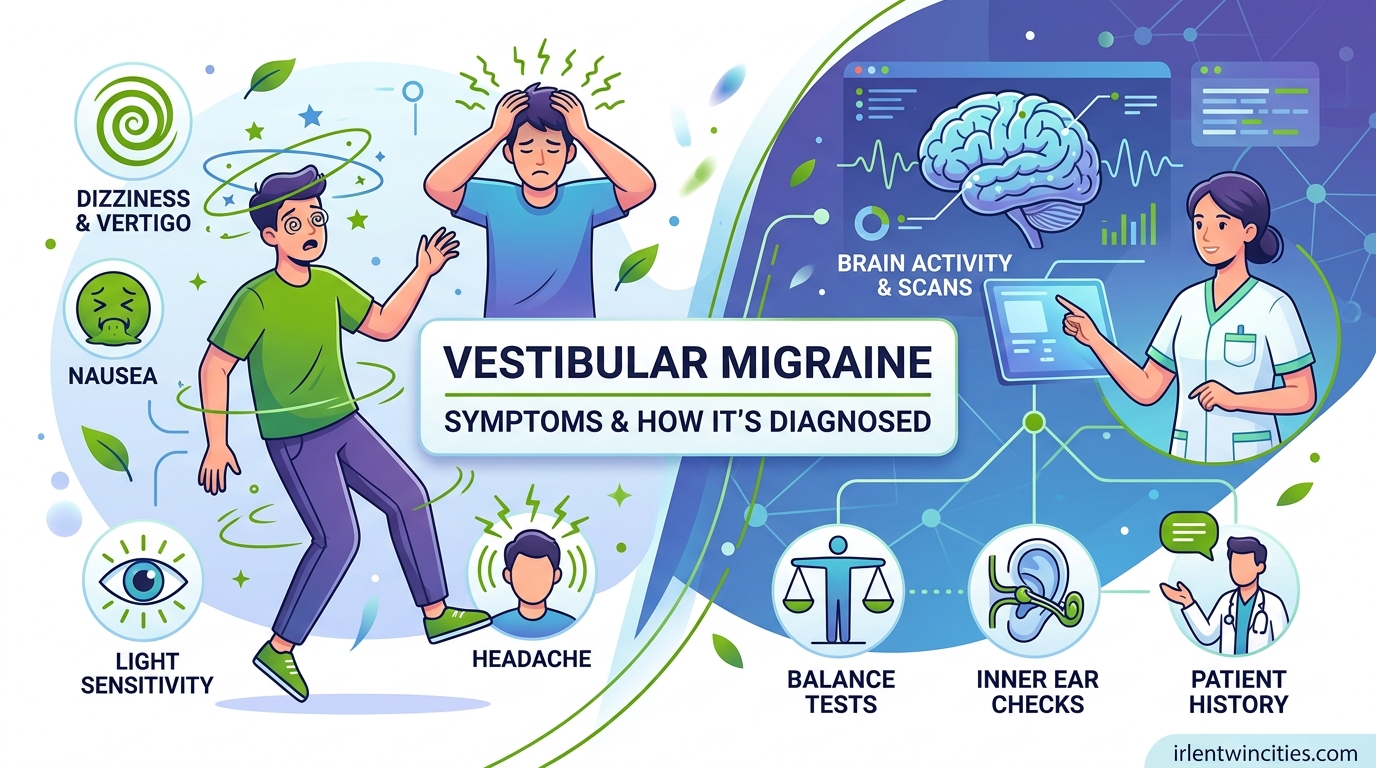
Vestibular migraine is a neurological condition that causes recurring vertigo, dizziness, and balance problems, often alongside typical migraine symptoms like headache, nausea, and sensitivity to light and sound. If you’ve been searching for answers about why you feel constantly unsteady or experience sudden spinning attacks, understanding how vestibular migraine works is the first step toward getting the right diagnosis and treatment.
Our team has spent years tracking how vestibular migraine affects patients differently from other types of migraine. What makes this condition particularly challenging is that it can occur with or without headache, which often leads to delayed diagnosis. In this guide, I’ll walk you through everything you need to know about vestibular migraine symptoms and how doctors confirm the diagnosis.
Table of Contents
What Is Vestibular Migraine?
Vestibular migraine is a type of migraine that affects the vestibular system, which controls your balance and spatial orientation. Unlike a typical migraine that focuses primarily on head pain, vestibular migraine causes the vestibular system to malfunction during attacks, leading to vertigo and dizziness.
The vestibular system includes the inner ear structures and parts of the brain that process balance and eye movements. When someone experiences vestibular migraine, the communication between these balance centers and the pain pathways in the brain becomes disrupted. This miscommunication triggers the characteristic vertigo even when a severe headache may not be present.
Research shows vestibular migraine is the second most common cause of vertigo, affecting up to 1% of the general population. It tends to run in families, with many patients reporting a history of motion sickness or traditional migraine headaches. The condition can develop at any age, though many people first notice symptoms in their 30s or 40s.
What I find important to note is that vestibular migraine can occur with or without the actual headache. This “silent” presentation often leads to years of misdiagnosis before patients finally see a specialist who recognizes the pattern.
Vestibular Migraine Symptoms
Vestibular Symptoms
The vestibular symptoms of this condition are what set it apart from other migraine types. These symptoms can be debilitating and often come on suddenly without warning.
Vertigo is the hallmark symptom. Patients describe this as a spinning sensation, like the room is moving around them. Some people experience external vertigo, where they feel like they or their surroundings are actually moving. Others have internal vertigo, feeling as though they are tilting, swaying, or floating even when standing still.
Many patients report that attacks feel like being drunk or seasick. One person described it as “constantly feeling like I’m on a boat, even when I’m standing in my kitchen.” This persistent unsteadiness can last for hours or days, making simple tasks like walking to the grocery store feel impossible.
Balance problems are extremely common. During an attack, you might feel like you might fall over with any sudden movement. Some people describe their legs feeling wobbly or their body feeling heavy and disconnected. Eye movement abnormalities called nystagmus often accompany these balance issues.
Visual disturbances frequently occur during attacks. Patients report blurry vision, tunnel vision, difficulty focusing, and feeling like the world is wobbling or shaking. These visual symptoms can persist even after the spinning sensation subsides.
Migraine Symptoms
While headache isn’t always present, when it does occur, it typically feels like a throbbing or pulsing pain on one side of the head. The headache often worsens with physical activity and can be aggravated by bright lights, loud sounds, or strong smells.
Phonophobia (sensitivity to sound) and photophobia (sensitivity to light) occur in most patients. Many find that normal everyday sounds feel painfully loud during attacks. Similarly, exposure to fluorescent lights, sunlight, or even screen brightness can intensify symptoms significantly.
nausea and vomiting frequently accompany vestibular symptoms. For many patients, the nausea is actually the most disabling part of an attack, preventing them from eating or staying hydrated during episodes.
Osmophobia, or sensitivity to smells, is another common complaint. Patients often report that odors they normally don’t notice become overwhelming during attacks, particularly perfume, cigarette smoke, or chemical fumes.
What Attacks Feel Like
Real patient experiences reveal how varied and unpredictable attacks can be. Some people experience distinct episodes lasting 5 minutes to 72 hours, while others have a constant baseline of mild dizziness with episodic worsens.
Common descriptions from forums include feeling “weird head pressure, not a typical headache,” experiencing “brain fog and cognitive issues” during attacks, and noticing “tinnitus and ear fullness” alongside the vertigo. Some patients report hot flashes or chills during episodes, while others notice mood changes including anxiety and depression both during and between attacks.
Causes and Triggers
The exact cause of vestibular migraine isn’t fully understood, but researchers believe it’s related to the same neurological mechanisms that cause regular migraine. Genetic factors appear to play a significant role, with many patients reporting a family history of migraine or motion sickness.
Common triggers include stress and anxiety, hormonal changes (particularly in women around menstruation or menopause), lack of sleep or irregular sleep patterns, and weather changes including barometric pressure shifts. Certain foods can also trigger attacks, including aged cheeses, processed meats, chocolate, caffeine, and alcohol.
Motion is a major trigger for many patients. Car rides, scrolling on phones, watching movies with lots of movement, and even walking through crowded spaces can bring on symptoms. This motion sensitivity often extends back to childhood for many patients, who report a lifelong history of car sickness or difficulty with activities like reading in moving vehicles.
Dehydration and skipped meals are common triggers. Some patients find that going too long without eating or not drinking enough water will reliably bring on an attack within hours.
How Vestibular Migraine Is Diagnosed
Diagnosing vestibular migraine involves a combination of clinical history, symptom assessment, and ruling out other conditions. There’s no single test that confirms the diagnosis, so doctors rely heavily on your description of symptoms and how they match established diagnostic criteria.
The ICHD-3 Diagnostic Criteria
The International Classification of Headache Disorders, Third Edition (ICHD-3) provides the standard diagnostic criteria for vestibular migraine. According to these criteria, you need:
First, at least five episodes of vestibular symptoms lasting 5 minutes to 72 hours. These vestibular symptoms must be moderate to severe, meaning they interfere with or prohibit daily activities.
Second, a current or previous history of migraine with or without aura. This means you’ve experienced or still experience the typical headache, light sensitivity, sound sensitivity, or visual aura symptoms of migraine.
Third, one or more migraine features must accompany at least half of the vestibular episodes. These features include headache, light sensitivity, sound sensitivity, or visual aura.
Fourth, the symptoms cannot be better explained by another vestibular disorder or headache condition.
Who Can Diagnose This Condition
Several types of specialists can diagnose and treat vestibular migraine. Neurologists are often the first stop, particularly those specializing in headache or vestibular disorders. They can rule out other neurological causes and confirm the diagnosis based on your symptom history.
Neuro-otologists (also called vestibular neurologists) specialize specifically in inner ear and balance disorders. These specialists have the most experience distinguishing vestibular migraine from other balance disorders and can perform detailed vestibular function testing.
Otolaryngologists (ENT doctors) can also help evaluate balance symptoms and rule out inner ear conditions like Meniere’s disease. Often, the diagnostic process involves seeing multiple specialists before reaching the correct diagnosis.
Vestibular Function Tests
While no test definitively confirms vestibular migraine, several assessments help rule out other conditions. These tests measure how well your vestibular system is functioning and can identify other causes of vertigo.
Electronystagmography (ENG) or videonystagmography (VNG) records eye movements during various stimuli, including changes in head position and visual tracking. Abnormal eye movement patterns can indicate vestibular dysfunction.
Rotational chair testing evaluates how your vestibular system responds to slow, sustained movements. This helps doctors understand if both inner ears are functioning properly and equally.
Other tests like vestibular evoked myogenic potentials (VEMP) and computerized dynamic posturography may be used in some cases to assess specific aspects of vestibular function.
Conditions That Mimic Vestibular Migraine
Because many vestibular conditions share similar symptoms, doctors must carefully rule out other possibilities before confirming vestibular migraine. Understanding the differences helps illustrate why diagnosis can take time.
Comparison: Vestibular Migraine vs Other Conditions
| Feature | Vestibular Migraine | BPPV | Meniere’s Disease | TIA (Mini-Stroke) |
|---|---|---|---|---|
| Duration of Episodes | 5 minutes to 72 hours | Seconds to under 1 minute per episode | 20 minutes to several hours | Minutes to hours (but typically fixed) |
| Hearing Loss | None | None | Progressive, fluctuating | Possible (depending on location) |
| Tinnitus | Possible during attacks | Rare | Common, prominent | Possible |
| Ear Fullness | Sometimes | No | Yes, prominent | Rare |
| Headache | Common but not required | Uncommon | Sometimes | Possible |
| Triggered by Head Position | No (unless combined with BPPV) | Yes (specific positions) | No | No |
| Nystagmus Pattern | Variable, can change direction | Rotational, predictable | Horizontal-torsional | Direction varies |
BPPV (Benign Paroxysmal Positional Vertigo)
BPPV causes brief spinning episodes triggered by specific head movements, like rolling over in bed or looking up. Each episode lasts seconds to under a minute. Unlike vestibular migraine, BPPV doesn’t cause headache, nausea (beyond brief spinning sensation), or sound and light sensitivity.
Meniere’s Disease
Meniere’s disease involves episodic vertigo, hearing loss, tinnitus, and ear fullness. The hearing loss is progressive and fluctuating, typically affecting one ear. Vestibular migraine doesn’t cause hearing loss, which helps distinguish the two conditions.
TIA (Transient Ischemic Attack)
A TIA or “mini-stroke” can cause sudden vertigo and imbalance, but symptoms don’t come and go like vestibular migraine attacks. TIAs also often involve other neurological symptoms like weakness, speech difficulties, or vision changes. Any sudden onset of severe vertigo, especially in someone without migraine history, warrants immediate medical evaluation to rule out stroke.
Treatment Options
Treatment for vestibular migraine typically involves both acute measures to stop attacks and preventive strategies to reduce frequency and severity over time.
Acute Treatments
During an attack, patients often find relief by resting in a quiet, dark room. Staying hydrated and sipping clear fluids helps with nausea. Some patients use over-the-counter pain relievers or anti-nausea medications early in an attack, though these work best when taken at the first sign of symptoms.
Prescription acute treatments include triptans, which are migraine-specific medications that can be effective if taken early. Anti-nausea medications like ondansetron or promethazine help control the nausea and vomiting that often accompany attacks.
Preventive Medications
For patients with frequent attacks, preventive medications may be recommended. Common options include beta-blockers like propranolol, tricyclic antidepressants like amitriptyline, and calcium channel blockers like verapamil or flunarizine.
Anticonvulsants like topiramate are sometimes used, particularly if migraine headaches are also frequent. CGRP inhibitors, a newer class of migraine preventives, may also be helpful, though research specifically in vestibular migraine is still emerging.
Lifestyle Modifications
Many patients find significant improvement through lifestyle changes. Identifying and avoiding personal triggers is crucial. Keeping a symptom diary helps recognize patterns and trigger foods, sleep issues, or stress factors.
Migraine diet modifications help some patients. This typically involves reducing intake of aged cheeses, processed meats, artificial sweeteners, caffeine, and alcohol while maintaining regular meal times and adequate hydration.
Vestibular rehabilitation therapy, a specialized form of physical therapy, can help improve balance and reduce motion sensitivity over time. This therapy involves exercises to train the vestibular system and improve compensation for balance disturbances.
When to Seek Emergency Care
While vestibular migraine is not life-threatening, some symptoms warrant immediate medical evaluation. You should seek emergency care if you experience sudden onset of severe vertigo with any of the following: severe headache unlike any you’ve had before, difficulty speaking or forming words, weakness or numbness on one side of the body, vision changes in one or both eyes, or confusion or disorientation that doesn’t resolve.
These symptoms could indicate a stroke or other serious condition. When in doubt, err on the side of caution and get evaluated. Once you’ve been evaluated and have a vestibular migraine diagnosis, you and your doctor can develop a plan for managing attacks at home.
How to confirm vestibular migraines?
Diagnosis is based on clinical history matching ICHD-3 criteria: at least five episodes of moderate-to-severe vestibular symptoms lasting 5 minutes to 72 hours, current or previous migraine history, and migraine features during at least half of episodes. Vestibular function tests help rule out other conditions.
What can be mistaken for a vestibular migraine?
BPPV, Meniere’s disease, TIA, and other vestibular disorders share similar symptoms. Key differences: BPPV causes brief seconds-long episodes triggered by head position. Meniere’s includes progressive hearing loss and prominent tinnitus. TIA symptoms are fixed rather than episodic.
What is the most common trigger of vestibular migraine?
Common triggers include stress, hormonal changes, lack of sleep, weather changes, certain foods (aged cheese, processed meats, caffeine, alcohol), dehydration, and motion. Many patients report lifelong motion sensitivity extending back to childhood.
Do you need to see a neurologist for vestibular migraines?
While primary care doctors can make an initial diagnosis, seeing a neurologist (ideally one specializing in headache or vestibular disorders) or neuro-otologist is recommended for confirmation and management, especially if symptoms are frequent or severe.
What do vestibular migraines feel like?
Patients describe vertigo as spinning (external) or tilting/floating (internal). Many feel like being drunk or seasick constantly. Attacks may include brain fog, blurry vision, nausea, head pressure without typical headache, and sensitivity to lights, sounds, or smells.
Is vestibular migraine dangerous?
Vestibular migraine itself is not life-threatening. However, the dizziness and balance problems increase fall risk. Sudden severe vertigo with unusual headache, weakness, or speech problems requires emergency evaluation to rule out stroke.
Living with Vestibular Migraine
Managing vestibular migraine requires patience and persistence. Finding the right treatment combination often takes trial and error, and what works for one person may not work for another. Working closely with a specialist who understands this condition makes a significant difference in outcomes.
The impact on daily life can be substantial. Many patients report avoiding activities they once enjoyed, struggling with work responsibilities, and experiencing anxiety about having attacks in public. The unpredictable nature of episodes affects not just physical function but emotional well-being and quality of life.
Support from healthcare providers, family, and others who understand the condition makes a meaningful difference. Connecting with patient communities, whether online forums or local support groups, provides practical tips and emotional validation that medical appointments alone cannot offer.
If you’re experiencing symptoms that sound like vestibular migraine, consider scheduling an evaluation with a neurologist or neuro-otologist. Getting a proper diagnosis opens the door to targeted treatments that can significantly reduce attack frequency and severity, helping you regain function and quality of life.