
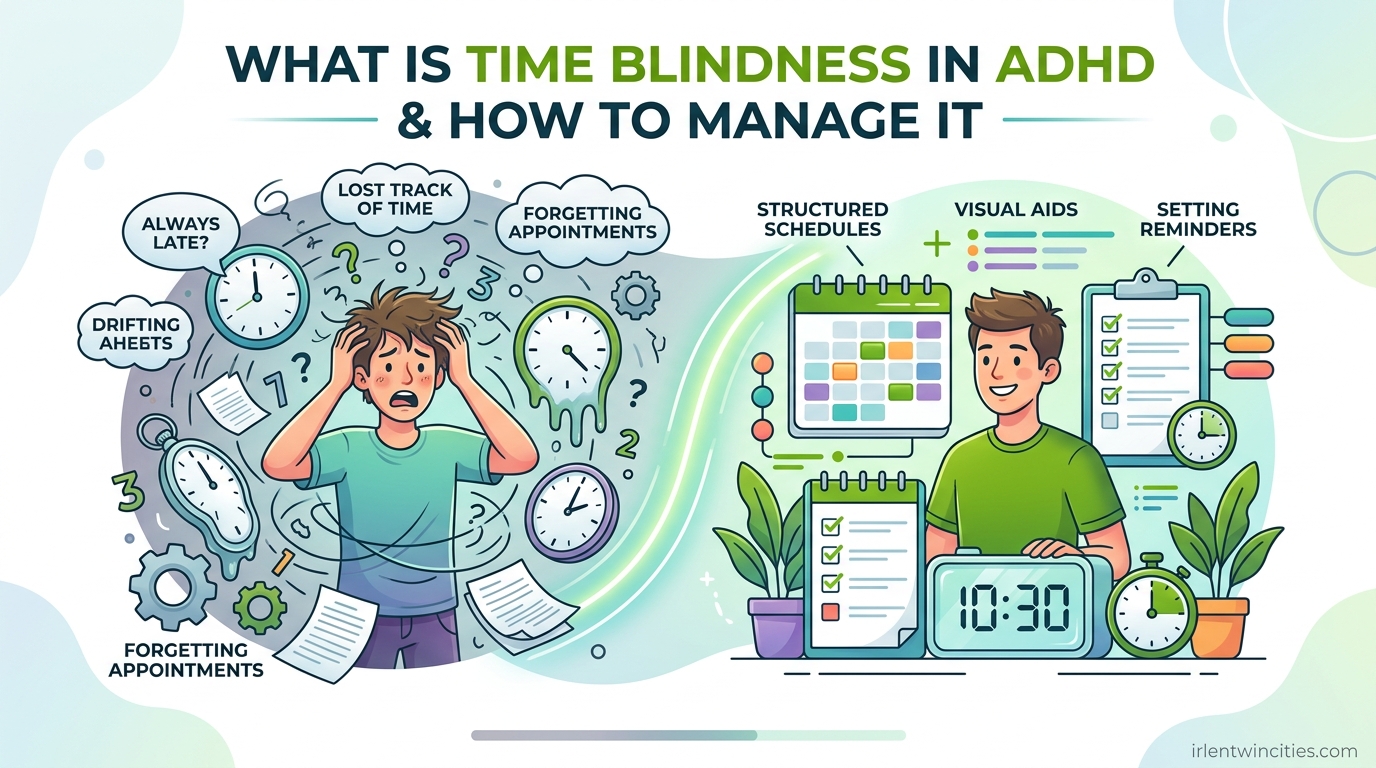
You sit down to answer a quick email at 9:00 AM. The next time you look up, it’s somehow 11:30 AM. Your coffee has gone cold. You have a meeting in 15 minutes that you swore wasn’t for another hour. Your heart races as you realize you’ve done it again.
If this scenario feels painfully familiar, you’re experiencing what people with ADHD call time blindness. It’s not a character flaw. It’s not laziness. It’s a real neurological difference that affects millions of adults with ADHD.
In this guide, I’ll explain exactly what time blindness in ADHD is, why it happens in your brain, and most importantly, how to manage it with practical strategies that actually work. I’ve spent 2026 researching ADHD management techniques, consulting with professionals, and gathering insights from the ADHD community to bring you actionable advice.
Table of Contents
What Is Time Blindness in ADHD?
Time blindness in adult ADHD is the inability to sense how much time has passed and estimate the time needed to get something done. It’s not about being forgetful or disorganized. It’s a fundamental difference in how your brain perceives the passage of time.
Think of it this way: Most people have an internal clock that ticks steadily in the background. They can feel when five minutes have passed. They intuitively know how long a shower takes. They sense when they need to leave for an appointment without constantly checking a watch.
With time blindness, that internal clock is essentially broken. Ten minutes and fifty minutes can feel identical. You might hyperfocus for six hours and believe only one has passed. Alternatively, you might stare at a clock watching minutes crawl by when waiting for something.
The Five Types of Time Challenges
Time blindness isn’t just one thing. Research and clinical experience show that people with ADHD experience five distinct types of time perception difficulties. Understanding which ones affect you helps you choose the right strategies.
Time perception is the basic ability to sense how much time has passed. Without external cues, you genuinely cannot tell if you’ve been working for 20 minutes or two hours. This is the core experience most people describe when talking about time blindness.
Time estimation involves predicting how long tasks will take. You might think grocery shopping takes 15 minutes when it really takes 45. You consistently underestimate project timelines, leading to missed deadlines and frantic last-minute rushes.
Time horizon refers to how far into the future you can effectively plan. Events beyond a certain point feel unreal, distant, or invisible. A deadline three weeks away might as well not exist until suddenly it’s tomorrow and panic sets in.
Time sequencing is understanding the order of events and how long each takes. You might struggle to figure out what to do first when getting ready, or constantly misjudge how long each step of your morning routine requires.
Time reproduction means you can’t consistently replicate time intervals. If someone asks you to wait five minutes, you might wait two or twelve without realizing it.
Real-Life Examples of Time Blindness
Here is what time blindness actually looks like in daily life. You sit down to check social media “real quick” and emerge three hours later confused about where the time went. You tell your partner you’ll be ready in ten minutes, then genuinely believe that’s accurate when 45 minutes pass.
You miss appointments not because you forgot them, but because you thought you had plenty of time when you didn’t. You arrive either very early or very late, rarely on time, because you cannot calibrate your preparation speed.
You experience something called “waiting mode,” where you cannot start any meaningful task before an upcoming event, even if that event is hours away. The time between now and then feels suspended, unusable.
As one person in the ADHD community shared: “Time blindness is the biggest problem I have because it robs me of time and trust, trust that I work hard for but that effort becomes invisible.” That sentiment captures the invisible weight many adults carry.
Signs and Symptoms of Time Blindness
Recognizing time blindness in yourself starts with identifying the patterns. These signs show up consistently across different areas of life. If you notice several of these describing your experience, time blindness likely affects you.
You are chronically late despite your best intentions and genuine efforts to be on time. You lose track of time during activities, especially enjoyable ones, experiencing what feels like time warps. You consistently underestimate how long tasks take, even tasks you’ve done hundreds of times before.
You struggle to start tasks because you cannot feel when you should begin. You experience anxiety around time, clocks, and schedules that others don’t seem to share. You need constant external reminders like alarms, apps, or people prompting you.
You miss deadlines not from procrastination but from genuine misjudgment of available time. You feel either rushed or waiting, rarely in a comfortable middle zone. You lose objects because you put them down “for a second” that stretched much longer.
Time Blindness vs. Procrastination
People often confuse time blindness with procrastination, but they are fundamentally different. Understanding this distinction matters because it changes how you address the problem and how you talk to yourself about it.
Procrastination is choosing to delay a task, usually because of anxiety, perfectionism, or low motivation. You know you should start but actively decide not to. With time blindness, you genuinely believe you have plenty of time left. You’re not avoiding the task. You’re misreading the clock.
Procrastination often involves conscious distraction: “I’ll just check one email first.” Time blindness involves unconscious time loss. You sit down to work, blink, and somehow an hour disappeared while you were focused. The time loss surprises you. It feels like theft.
Procrastination feels like a battle with yourself. Time blindness feels like the universe is gaslighting you about reality. Both can result in missed deadlines, but they require different solutions. Procrastination needs motivation and anxiety management. Time blindness needs externalization and structural support.
What Causes Time Blindness? The Brain Science
Time blindness is not a moral failing. It’s not about willpower or caring enough. It stems from measurable neurological differences in how the ADHD brain processes time. Understanding this science helps remove shame and guides effective treatment.
The Prefrontal Cortex Connection
The prefrontal cortex sits behind your forehead and serves as your brain’s executive control center. It manages planning, impulse control, working memory, and yes, time perception. In ADHD brains, this region shows reduced activity and connectivity compared to neurotypical brains.
Think of your prefrontal cortex as a conductor leading an orchestra. In neurotypical brains, the conductor keeps all sections synchronized. The percussion keeps steady time. The strings swell at the right moment. Everything flows together.
In ADHD brains, that conductor struggles. Sections play at different tempos. The internal metronome that tracks time passage loses its beat. Your brain cannot maintain the steady temporal reference point that most people take for granted.
Dopamine and Time Perception
Dopamine plays a crucial role in time perception, and ADHD involves dysregulated dopamine signaling. When dopamine flows freely, your brain marks time passage effectively. When dopamine is low or inconsistent, time perception distorts.
This explains why hyperfocus happens. During highly stimulating or interesting activities, dopamine floods your system. Time becomes irrelevant. Hours pass like minutes. Conversely, during boring activities with low dopamine, minutes feel like hours. Time stretches painfully.
Your brain uses dopamine hits to mark events in memory. Without consistent dopamine signaling, recent events blur together. Was that meeting yesterday or last week? Did you take your medication this morning? The timeline becomes fuzzy.
Working Memory and Time Tracking
Working memory is your brain’s temporary holding area for information you need right now. It’s essential for time management because you must hold your schedule, current time, and task duration in mind simultaneously.
ADHD brains typically have working memory deficits. You might check the clock, intend to leave in twenty minutes, then immediately lose that information. The time plan vanishes into the mental fog. You need to check again and again because the information won’t stick.
This working memory challenge also affects retrospective time estimation. Without clear memory markers, you cannot accurately reconstruct how long past activities took. Every estimate becomes a guess, often an optimistic one.
How Time Blindness Affects Daily Life
The impact of time blindness extends far beyond simply being late occasionally. It seeps into relationships, careers, self-esteem, and emotional wellbeing. Understanding these impacts validates your struggles and highlights why management strategies matter.
Workplace Consequences
At work, time blindness creates invisible stress that others may not recognize. You miss deadlines despite working hard because you cannot gauge project scope accurately. You arrive late to meetings, appearing unprofessional even when you tried your best.
You struggle with long-term projects because distant deadlines feel unreal until they become emergencies. You either rush at the last minute or miss targets entirely. Your performance reviews mention “time management issues” while your actual output quality remains high.
You may avoid jobs requiring strict punctuality or time tracking. Career options narrow not from lack of skill but from time perception differences. The constant vigilance required to compensate drains your energy and creativity.
Relationship Strain
Time blindness damages relationships in ways that feel invisible to you but glaring to others. Partners feel disrespected when you’re consistently late for dates or family events. Friends interpret your time loss as not caring about them.
You miss children’s events, anniversaries, or important moments not because they don’t matter but because time slipped away unnoticed. Family members learn not to rely on you for time-sensitive tasks. They stop asking.
The shame compounds over years. Each lateness adds to a story about you being flaky, unreliable, or selfish. You try harder, set more alarms, create more systems, but still fail. The gap between your intentions and outcomes widens into a painful chasm.
The Emotional Burden
Perhaps the heaviest cost is internal. Time blindness generates constant low-grade anxiety about clocks and schedules. You live with background stress about whether you’re measuring time correctly.
You internalize the judgment. You call yourself lazy, broken, or incapable. You wonder why basic adulting seems so hard for you when others handle it effortlessly. You hide your struggles, exhausting yourself maintaining the appearance of competence.
Here’s what you need to hear: This is not your fault. Time blindness is a neurological difference, not a character flaw. The shame belongs to the misunderstanding, not to you. Self-compassion is not just nice to have. It’s essential for moving forward.
How to Manage Time Blindness: Practical Strategies
While you cannot cure time blindness, you can manage it effectively. The key strategy is externalization: moving time tracking from inside your unreliable brain to outside systems you can see, hear, and trust. These techniques create structure that compensates for your internal clock’s limitations.
Externalize Time with Visual and Audible Cues
Your first line of defense is making time visible and audible. Visual timers like the Time Timer show time passing as a shrinking red wedge. You can literally see time disappearing, which helps ground you in temporal reality. Digital countdowns on phones or computers provide similar visual feedback.
Physical hourglasses offer elegant visual time tracking without screens. Kitchen timers with loud alarms break through hyperfocus when you need to transition. Smart watches with vibration alerts provide gentle time checks without disrupting others.
Set multiple alarms with different meanings. One alarm means “start wrapping up.” Another means “leave now.” A third means “you should already be there.” Build in buffer time between alarms so lateness becomes impossible rather than probable.
Time Blocking and Structured Scheduling
Time blocking involves assigning specific activities to specific time slots with clear boundaries. Rather than a vague to-do list, you create a concrete schedule with start and end times for each task. This structure compensates for poor internal time sensing.
Use color-coding to make your schedule visually scannable. Red for urgent, blue for work, green for personal. The visual pattern helps you quickly understand where you are in your day without reading every entry.
Build transition time between blocks explicitly. If a meeting ends at 2:00 PM and another starts at 2:00 PM, you’re set up for failure. Block 2:00 to 2:10 for transition. These buffers acknowledge that shifting activities takes time for ADHD brains.
Review your schedule at fixed anchor points throughout the day. Morning check-in, midday review, evening preparation. These rituals keep your timeline anchored in reality rather than drifting into fantasy.
Body Doubling for Accountability
Body doubling means working alongside another person who is also working. Their presence provides external structure that helps regulate your time perception. It’s remarkably effective and underutilized outside ADHD communities.
You don’t need someone watching you or helping with your task. Simply having another human in the room or on video call creates accountability. Their steady presence acts as an external metronome, keeping your timing grounded.
Virtual body doubling works through video calls where both parties work silently on their own tasks. ADHD-focused coworking spaces exist online specifically for this purpose. Some people use study streams on YouTube for the same effect.
Informal body doubling happens at coffee shops, libraries, or shared workspaces. The ambient human activity creates enough external time structure to help you track your own work pace. Many people with ADHD report dramatic productivity increases simply from working near others.
Technology Tools and Apps
Apps designed for time blindness can provide crucial external support. Structured is a daily planner app that breaks your day into visual blocks with clear timelines. Toggl Track logs how you actually spend time, revealing patterns your biased memory hides.
Forest gamifies focus time by growing virtual trees during work sessions. Routinery creates customizable routine timers for recurring sequences like morning preparation. Tiimo offers visual scheduling designed specifically for neurodivergent brains.
Use calendar apps with aggressive notifications. Set alerts for 30 minutes before events, 15 minutes before, 5 minutes before, and at start time. Multiple warnings compensate for your tendency to dismiss early alerts and immediately forget them.
The 10-Minute Check-In Strategy
One of the most effective practical techniques comes from the ADHD community: set a timer to check in every ten minutes. This breaks time into manageable chunks that your brain can process.
Start a 10-minute timer whenever you begin any activity. When it rings, ask yourself: “Am I doing what I intended? How much time has actually passed? What’s my next priority?” Reset the timer and continue.
For longer tasks, use a sequence of 10-minute intervals with specific micro-goals. “In this 10 minutes, I’ll finish the introduction.” The external structure prevents hours from vanishing unnoticed.
Some people prefer 15 or 20-minute intervals. Experiment to find your optimal rhythm. The goal is frequent enough grounding to prevent time loss, but not so frequent that you cannot enter flow states.
Emergency Strategies When Time Has Already Escaped
Despite your best systems, time will still escape occasionally. Have emergency protocols ready for these moments to minimize damage and recover quickly.
When you realize you’re running late, immediately communicate. Text or call the waiting person with your realistic arrival time, not your hopeful guess. Apologize briefly without over-explaining. Most people appreciate communication over perfection.
Use the “good enough” principle when time-pressured. Perfectionism burns precious minutes you don’t have. Identify the minimum viable version of what you need to accomplish and do only that. You can refine later if needed.
Keep emergency time buffers in your schedule. Block 30-minute “catch-up” periods after high-risk activities. If things go smoothly, you have bonus time. If time blindness strikes, you have a safety net.
Have a go-to “late kit” prepared: pre-stocked bag, planned outfits, quick meals. Reduce decision fatigue when you’re already stressed. Automate everything possible so only essential choices remain.
Workplace Accommodations for Time Blindness
Time blindness qualifies for workplace accommodations under the Americans with Disabilities Act (ADA). Knowing your rights and requesting appropriate support can transform your work experience from constant stress to sustainable success.
Reasonable Accommodations to Request
Flexible scheduling allows you to work during your most focused hours rather than rigid 9-to-5 requirements. Remote work options reduce commute stress and let you control your environment. Both accommodations acknowledge that traditional time structures don’t serve all brains equally.
Written instructions and clear deadlines in writing help compensate for working memory challenges. Visual project management tools like Trello or Asana provide external timelines you can see and reference. Access to time management training or ADHD coaching counts as professional development.
Meeting modifications make a huge difference. Request agendas in advance so you can prepare meaningfully. Ask for clear time boundaries: “This meeting will end at 2:00 PM.” Permission to use timers or alarms during work hours without judgment.
How to Talk to Your Employer
You don’t need to disclose your ADHD diagnosis to request accommodations. Frame your requests around productivity and performance. “I work best with written deadlines rather than verbal ones.” “I benefit from visual project tracking.”
If you choose to disclose, focus on solutions rather than problems. Come prepared with specific accommodation requests, not just a list of difficulties. Emphasize how these supports enable your best work.
Document your accommodation requests in writing. Keep records of conversations and agreements. This protects you if questions arise later and helps ensure consistent implementation.
Start with one or two accommodations rather than overwhelming requests. Build trust by demonstrating that supports improve your performance. Gradually add more as needed.
When to Seek Professional Help
While self-management strategies help significantly, professional support can accelerate your progress and address underlying factors. Knowing when and how to seek help ensures you get appropriate support.
Types of Professional Support
ADHD coaches specialize in practical strategies for daily life challenges. Unlike therapists who explore emotional patterns, coaches focus on systems, structures, and skills. They help you build personalized time management approaches that fit your specific life.
Cognitive behavioral therapy (CBT) adapted for ADHD addresses negative thought patterns around time management. It helps challenge beliefs like “I’m just lazy” or “I’ll never be on time.” CBT also builds executive function skills through structured practice.
Psychiatrists or primary care doctors can discuss medication options. Stimulant medications often improve time perception significantly by normalizing dopamine signaling. Non-stimulant options exist for those who cannot or prefer not to use traditional ADHD medications.
Occupational therapists help with sensory and environmental modifications that support time awareness. They might recommend specific timers, workspace arrangements, or routine structures tailored to your sensory needs.
Finding the Right Professional
Look for professionals who specifically mention ADHD or executive function in their expertise. General therapists or coaches without neurodivergent specialization may not understand time blindness as a neurological difference rather than a behavioral problem.
Ask potential providers about their experience with ADHD adults. Do they understand time blindness specifically? What approaches do they use? Do they offer practical skill-building or just talk therapy?
Many communities have ADHD support groups where members share provider recommendations. Online directories like CHADD’s professional directory or ADDA’s resource lists can help you find qualified help in your area or virtually.
Professional help works best as a complement to your self-management efforts, not a replacement. The combination of external tools and professional guidance creates the strongest foundation for managing time blindness effectively.
Frequently Asked Questions
Is time blindness a real thing or just an excuse?
Time blindness is absolutely real. Research using brain imaging consistently shows that ADHD brains process time differently than neurotypical brains. The prefrontal cortex and dopamine systems involved in time perception show measurable differences. Time blindness appears in diagnostic criteria and is recognized by medical professionals. It’s not laziness, lack of caring, or making excuses. It’s a neurological difference with biological roots.
What is the difference between time blindness and procrastination?
Time blindness involves misperceiving time, while procrastination involves choosing to delay. With time blindness, you genuinely believe you have plenty of time left. You’re not avoiding the task. You’re misreading the clock. Procrastination feels like a battle with yourself where you choose distraction. Time blindness feels like time disappeared without your awareness or consent. Both cause delays, but they need different solutions.
Can you have reverse time blindness where you’re always early?
Yes, some people with ADHD experience reverse time blindness, arriving chronically early rather than late. This happens when your brain compensates by adding excessive buffer time to every estimate. The anxiety about being late becomes so strong that you overcorrect dramatically. You might arrive 45 minutes early for appointments because you cannot trust your time sense. This creates its own problems: wasted time, resentment from others who feel rushed, and constant waiting-mode anxiety.
Does time blindness get worse with age?
Time blindness doesn’t necessarily worsen with age, but life demands often increase. Adults face more complex schedules, longer-term projects, and higher stakes for time management. These increased demands can make time blindness feel more problematic even if the underlying time perception remains stable. On the positive side, adults often develop better coping strategies over time and may find effective workarounds that weren’t available in childhood.
Can time blindness be cured?
Time blindness cannot be cured because it’s rooted in brain structure and function. However, it can be effectively managed through strategies that externalize time tracking, medication that improves time perception, and environmental modifications that compensate for internal time tracking difficulties. Most adults with ADHD find that proper management makes time blindness a manageable aspect of life rather than a debilitating one. The goal is accommodation and compensation, not cure.
How do I explain time blindness to skeptical partners or family?
Focus on the neurological explanation rather than symptoms. Explain that your brain literally processes time differently. Use analogies like having a broken internal clock. Share specific examples of how time blindness affects you, not just that you’re late. Provide articles or medical sources that validate time blindness as real. Ask for specific accommodations rather than general understanding. Sometimes showing works better than telling. Let them observe your systems in action.
What apps work best for time blindness?
Visual timer apps like Time Timer, Structured for visual daily planning, Routinery for routine sequences, and Toggl Track for time logging work well. The best app depends on your specific time challenges. Visual people benefit from color-coded calendars. Auditory people need alarm-heavy systems. Experiment with several to find what fits your brain. Many people use multiple apps for different situations.
How do I deal with the anxiety around time blindness?
Anxiety about time often comes from repeated negative experiences and internalized shame. Self-compassion is crucial. Remind yourself that time blindness is neurological, not moral. Build reliable external systems so you can trust your structures rather than your internal clock. Consider therapy specifically for the emotional aspects. Practice mindfulness to ground yourself in present time rather than worrying about future time. Connect with ADHD communities for validation and shared understanding.
Conclusion
Time blindness in ADHD is a real neurological difference that makes perceiving and managing time genuinely difficult. It’s not laziness, lack of caring, or a character flaw. Your brain processes time differently, and that difference requires different strategies.
The path forward involves externalizing time through visual and audible tools, building structured systems that compensate for internal clock limitations, and seeking professional support when needed. Body doubling, time blocking, and the 10-minute check-in strategy transform abstract time into concrete manageable chunks.
Most importantly, practice self-compassion. The shame you’ve carried about time management belongs to misunderstanding, not to you. You are working hard within a brain that doesn’t track time automatically. That effort matters even when outcomes don’t match intentions.
Start with one strategy from this guide. Maybe it’s buying a visual timer. Maybe it’s finding a body doubling partner. Maybe it’s simply accepting that your brain works differently and that’s okay. Small steps compound into significant change. You’ve got this.