
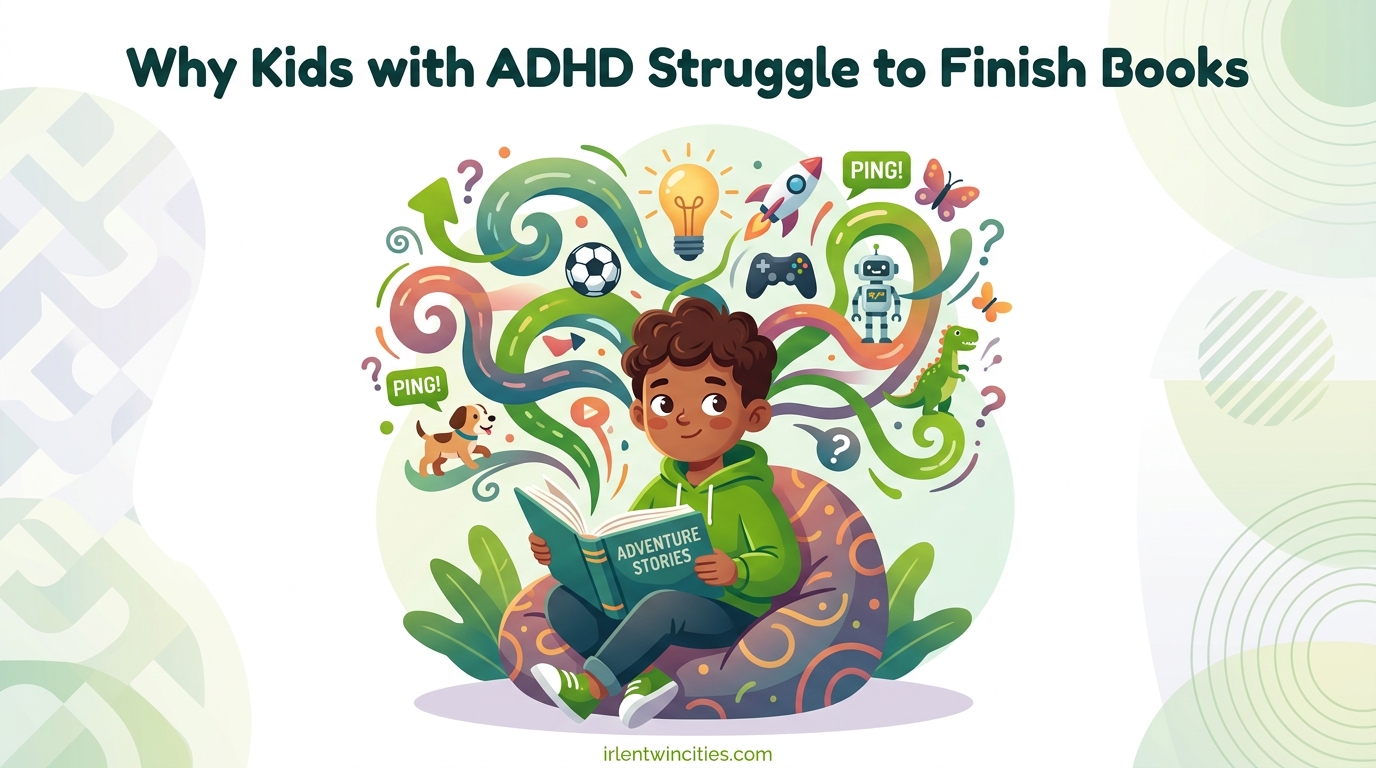
Watching your child start yet another book, only to abandon it halfway through, can feel heartbreaking. You are not alone in this frustration. Millions of parents of children with ADHD face this same challenge daily, and it has nothing to do with intelligence or interest in stories.
In this guide, we will explore why kids with ADHD struggle to finish books, what is happening in their brains, and most importantly, what you can do to help them develop lasting reading skills. Our team has spent months reviewing research, talking to parents, and analyzing expert findings to bring you answers that actually work.
Table of Contents
Understanding the ADHD-Reading Connection
The question “why do kids with ADHD struggle to finish books” has a clear scientific answer. ADHD affects the way the brain processes information, manages focus, and responds to rewards. Understanding this connection helps explain why traditional reading encouragement often falls short.
The Dopamine Factor
Children with ADHD have dopamine systems that work differently. Dopamine is a neurotransmitter that creates feelings of satisfaction and motivation. For children with ADHD, the brain seeks dopamine more aggressively because it processes this chemical differently.
Books, especially chapter books, offer slow, delayed rewards. The satisfaction of finishing a chapter or completing a book comes gradually. This delayed gratification clashes with the ADHD brain’s preference for instant stimulation. That is why many kids with ADHD can start books easily but cannot push through to the end.
Research from the American Academy of Pediatrics confirms that dopamine-seeking behavior is a core characteristic of ADHD. When reading does not provide quick dopamine hits, the brain naturally gravitates toward more stimulating activities like video games or social media.
Executive Function Delays
Executive function refers to the brain’s ability to plan, organize, and complete tasks. In children with ADHD, executive function develops approximately 30% slower than in neurotypical children. This delay means that abilities like prioritizing reading over other activities, breaking a book into manageable sections, and tracking progress become significantly harder.
Your child is not being lazy or stubborn. Their brain is genuinely working differently. The cognitive load required to start a book, maintain attention through chapters, and remember earlier plot points creates a heavier mental burden than you might expect.
Why Finishing Books Feels Impossible
If your child starts books enthusiastically but never finishes them, you are witnessing a pattern, not a personality flaw. This pattern has specific neurological explanations that parents need to understand.
Working Memory Overload
Working memory is the brain’s notepad for temporary information storage. When reading, working memory holds character names, plot details, and context while you process each sentence. For children with ADHD, working memory capacity is often limited, which creates comprehension gaps.
Imagine your child reads a chapter on Monday. By Tuesday, when they pick up the book again, the earlier details have faded from working memory. This creates confusion and frustration. The solution seems obvious: start over. But starting repeatedly leads to boredom, and boredom leads to abandonment.
Parents in our forums describe watching their children read the same paragraph four or five times, still not understanding it. This is not a reading disability. It is working memory overload combined with attention fluctuation, both hallmarks of ADHD.
The Understimulation Problem
Many people assume ADHD children are overstimulated and need to calm down. Sometimes the opposite is true. Understimulation occurs when an activity fails to engage the brain enough to hold attention. Books that move slowly or have complex prose can cause understimulation, leading to daydreaming and distraction.
Your child might not be distracted by something more interesting. They might simply be understimulated by the book itself. This is why graphic novels, audiobooks with engaging narrators, and books with fast-paced plots often work better for ADHD readers.
One parent shared that her son read 15 graphic novels in one summer after struggling with chapter books for years. The visual input provided enough stimulation to hold his attention while the reduced text load made comprehension manageable.
The 30% Rule for ADHD
Here is something no competitor article explains well: the 30% rule for ADHD and executive function. Research indicates that executive function skills in children with ADHD develop approximately 30% slower than their neurotypical peers. This means a 10-year-old with ADHD might have executive function abilities closer to a 7-year-old.
This developmental delay explains why reading expectations designed for neurotypical children often fail for those with ADHD. Asking a 10-year-old with ADHD to track a complex plot across 20 chapters is equivalent to asking a 7-year-old to do the same task. The expectation exceeds their current neurological capacity.
Understanding the 30% rule changes how parents approach reading. Instead of pushing harder, you can adapt expectations. Short chapters, frequent breaks, and books matched to your child’s emotional age rather than their chronological age produce better results.
This rule also explains why children with ADHD often excel at reading topics they love while struggling with assigned reading. Interest provides motivation that compensates for executive function delays. When your child reads about dinosaurs or favorite video games, their brain engages differently than when reading about historical fiction or science passages.
Practical Strategies to Help Your Child Finish Books
Knowing why your child struggles matters. What matters more is knowing what to do about it. These strategies come from parent feedback, expert recommendations, and real-world testing.
The 10-3 Rule
The 10-3 rule is simple: read for 10 minutes, then take a 3-minute break. This technique works because it aligns with ADHD attention patterns. Most children with ADHD can focus intently for 8-12 minutes before attention drifts. By structuring reading sessions around natural attention cycles, you reduce frustration and increase retention.
During the 3-minute break, encourage movement. Stretching, jumping jacks, or fidget tools help discharge restless energy. When your child returns to reading, they begin fresh rather than fighting against fading concentration.
Many parents report that switching to 10-3 sessions transformed their child’s reading experience. One father said his daughter went from abandoning books after two pages to finishing entire novels using this method. The key is consistency: the 10-3 rhythm should become a routine, not a suggestion.
Body Doubling and Fidget Tools
Body doubling means being present in the room while your child reads. You do not need to read together or interact. Simply existing nearby provides a grounding effect that helps some ADHD children maintain focus. This technique comes directly from the ADHD community, where body doubling is widely used for task completion.
Fidget tools serve a similar purpose. When hands have something to do, the brain can focus better on reading. Fidget spinners, stress balls, or textured strips give the body occupation while the mind engages with text. The key is choosing quiet, non-distracting tools that occupy the hands without pulling attention away from reading.
Online communities report success with numerous variations. Some parents sit in the same room doing paperwork while their child reads. Others use video calls as body doubling for children who need remote presence. Experiment to find what works for your family.
Choosing the Right Books
Book selection matters more for ADHD readers than for neurotypical readers. Matching books to your child’s interests and attention patterns dramatically increases completion rates. Fantasy series with short chapters, graphic novels with engaging visuals, and high-interest non-fiction often outperform traditional chapter books.
Do not assume your child must read grade-level books. Reading slightly below their reading level with high-interest content builds confidence and stamina. Once your child experiences the satisfaction of finishing books, they can gradually handle more challenging material.
Consider audiobooks as a valid reading alternative. Many children with ADHD absorb audiobooks more easily than print versions. The narrator’s voice provides stimulation that written text lacks. Audiobooks do not replace reading skills but they build comprehension, vocabulary, and exposure to stories your child might not otherwise access.
Age-Specific Challenges and Solutions
ADHD affects reading differently across developmental stages. Understanding what to expect at each age helps you set realistic goals and choose appropriate interventions.
Younger Children (6-9)
At this age, reading difficulties often manifest as an inability to sit still during reading time or refusing to read aloud. Children may become visibly frustrated after just a few minutes. Executive function delays are most pronounced at this stage, making sustained reading particularly challenging.
Strategy focus: Keep reading sessions very short (5-7 minutes), use heavily illustrated books, and emphasize reading aloud together rather than independent reading. Creating positive associations with books at this age prevents later resistance.
Older Children (10-13)
This age often brings social awareness that compounds reading struggles. Children recognize they read differently than peers, which can trigger shame and avoidance. Academic demands increase while reading difficulties remain consistent, creating growing frustration.
Strategy focus: Address emotional components alongside practical strategies. Validate your child’s feelings while introducing the 10-3 method and body doubling. Book selection becomes critical at this stage; let your child choose high-interest material even if it seems below their grade level.
Teenagers
Teenagers with ADHD who struggle to finish books often develop elaborate coping mechanisms or abandon reading entirely. Academic pressure peaks during high school, making reading difficulties feel increasingly consequential. Many teenagers report hiding their reading struggles from peers and teachers.
Strategy focus: Independence matters more than control. Introduce strategies your teenager can manage themselves rather than strategies you manage for them. Audiobooks, ebook apps with adjustable fonts, and text-to-speech features give teenagers tools they control. Focus on comprehension over completion; understanding what they read matters more than finishing every book.
Frequently Asked Questions
Do people with ADHD have trouble finishing books?
Yes, people with ADHD commonly struggle to finish books. This happens because ADHD affects executive function, working memory, and the brain’s dopamine reward system, making sustained focus and delayed gratification particularly challenging. The delayed satisfaction that comes from finishing a book clashes with the ADHD brain’s preference for instant stimulation.
What is the 30% rule of ADHD?
The 30% rule refers to the finding that executive function skills in children with ADHD develop approximately 30% slower than in neurotypical children. This means a 10-year-old with ADHD may have executive function abilities closer to a 7-year-old. Understanding this helps parents set realistic expectations for reading tasks.
What is the 10-3 rule for ADHD kids?
The 10-3 rule is a reading strategy where your child reads for 10 minutes, then takes a 3-minute movement break. This aligns with ADHD attention patterns since most children with ADHD can focus intensely for 8-12 minutes before attention fades. The structured breaks help maintain concentration across reading sessions.
What age is hardest for kids with ADHD?
The tween years (10-13) often present the hardest challenges for kids with ADHD and reading. At this age, social awareness increases, and children recognize they read differently than peers, triggering shame and avoidance. Academic demands also increase, compounding existing reading difficulties.
Conclusion
Understanding why kids with ADHD struggle to finish books changes everything. It shifts blame into understanding and frustration into strategy. The challenges your child faces are real, neurological, and surmountable with the right approach.
Remember that the 30% rule explains why traditional expectations often fail. Executive function delays mean your child needs more time, more breaks, and more engaging content than neurotypical readers. The 10-3 rule, body doubling, and careful book selection are not shortcuts; they are accommodations that work with your child’s brain rather than against it.
Your role is not to force reading. It is to create conditions where reading becomes possible and rewarding. Celebrate small victories. Finishing one chapter is progress. Reading for 10 minutes without stopping is achievement. These wins build toward lasting reading habits that will serve your child throughout their education and beyond.
If you have tried these strategies and your child still struggles, consider reaching out to an ADHD-aware reading specialist. Sometimes additional support uncovers underlying issues beyond ADHD that benefit from targeted intervention. You are not alone in this journey, and asking for help is a sign of strength, not failure.