
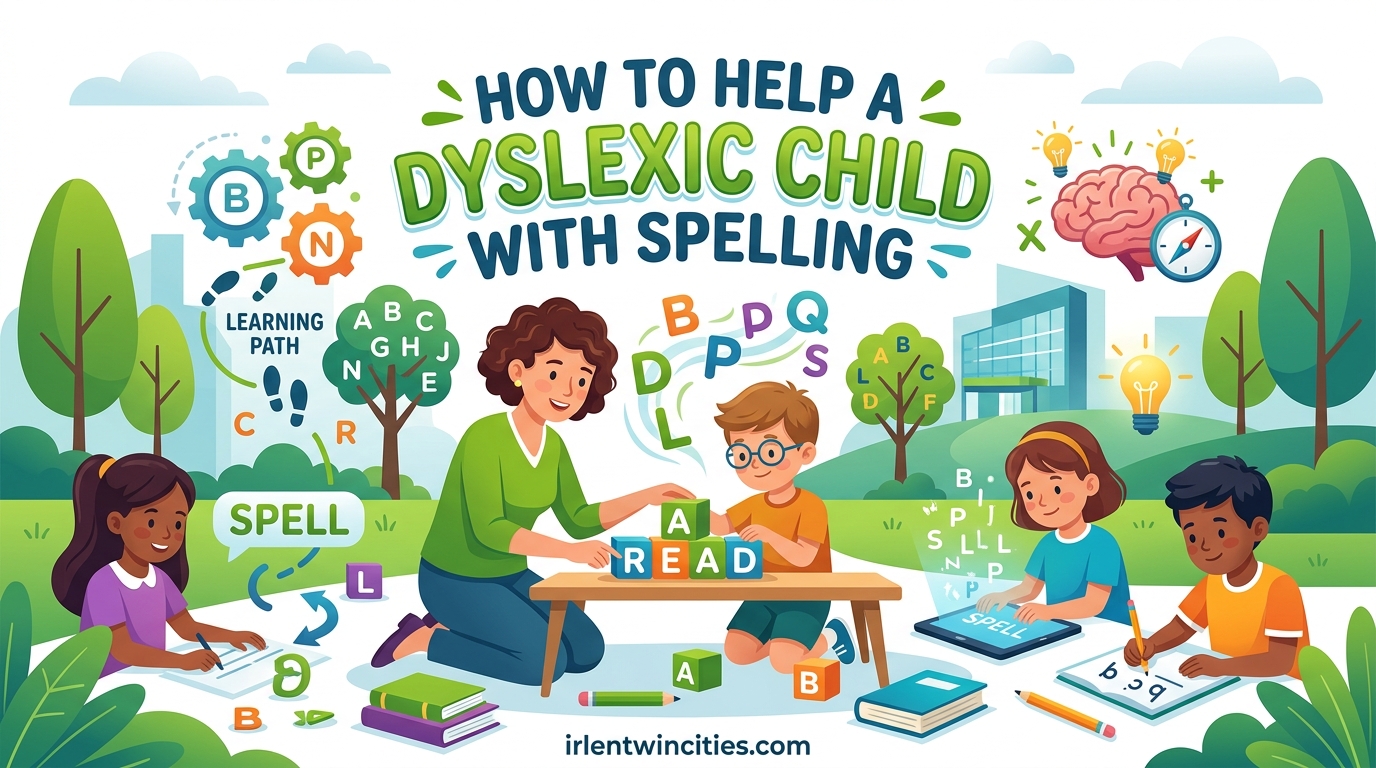
Watching your child struggle to spell simple words can be heartbreaking. If you’re searching for how to help a dyslexic child with spelling, you’re not alone — and you’re already taking an important step by seeking guidance. Children with dyslexia face unique challenges with spelling because their brains process language differently, but with the right strategies, consistent practice, and emotional support, significant improvement is absolutely possible.
In this comprehensive guide, you’ll discover evidence-based techniques used by dyslexia specialists, practical activities you can do at home, and emotional support strategies that make a real difference. Whether your child is just beginning to learn to spell or has been working on it for years, these approaches meet them where they are and help them move forward with confidence.
Table of Contents
Why Do Dyslexic Children Struggle with Spelling?
Understanding the root causes behind dyslexic spelling difficulties helps parents approach intervention with patience and purpose. Dyslexia affects how the brain processes phonological information — the sounds that make up language — and this directly impacts spelling ability.
The English spelling system is notoriously complex. Research shows that only about 50% of English words follow regular sound-to-letter patterns, 37% are semi-predictable, and roughly 4% are truly irregular. For a child whose brain struggles to connect sounds with written symbols, this inconsistency creates significant confusion.
Dyslexic children often experience what specialists call “orthographic processing difficulties” — essentially, their brains don’t automatically absorb spelling patterns the way non-dyslexic brains do. This means that while other children might learn to spell a word after seeing it several times, a dyslexic child may need dozens of exposures with explicit, multi-sensory instruction before the spelling becomes automatic.
Additionally, many dyslexic children have challenges with working memory, which affects their ability to hold spelling rules in mind while applying them. They may know a rule one day and seem to forget it the next — not because they aren’t trying, but because their working memory capacity is more limited in this area.
Understanding these underlying factors transforms how parents approach practice sessions. Rather than assuming a child “isn’t paying attention” or “should know this by now,” parents who understand the neurology of dyslexia can design practice that works with the child’s learning style rather than against it.
Multi-Sensory Spelling Techniques That Actually Work
Multi-sensory instruction is consistently rated as the gold standard for teaching dyslexic children to spell. The concept is simple: engage multiple senses simultaneously — sight, sound, touch, and movement — to create stronger neural pathways for memory encoding.
Building Letters with Multiple Senses
When introducing or practicing spelling words, encourage your child to form letters using multiple modalities:
- Skywriting: Have your child stand and trace large letters in the air while saying the letter name and its sound aloud
- Sand or Salt Tray: Sprinkle salt, sand, or sugar on a tray and let your child trace letters and words with their finger
- Texture Tracing: Use textured materials like sandpaper letters, wikki stix, or even shaving cream on a table surface
- Playdough Construction: Form letters and words from playdough or pipe cleaners
- Typing Practice: Have your child type spelling words on a keyboard, feeling the letter keys as they press them
Color Coding and Visual Highlighting
Visual processing challenges mean dyslexic children often benefit from color-coded approaches:
- Use different colored markers or highlighters for vowels versus consonants
- Highlight spelling patterns in one color (such as the “tion” ending in blue)
- Create color-coded flashcards with the word in black and the difficult letters in red
- Use colored overlays or tinted glasses if your child has visual processing sensitivities
Chunking Words into Syllables
Breaking words into smaller, manageable pieces reduces cognitive load. Teach your child to identify syllables by:
- Clapping out each syllable while saying the word slowly
- Using a colored pencil to highlight syllable boundaries on written words
- Learning common syllable patterns (closed syllables, open syllables, vowel teams)
- Practicing syllable division rules before tackling full words
Practical Activities to Practice Spelling at Home
Consistent, short practice sessions are more effective than long, frustrating ones. Aim for 10-15 minutes of focused spelling practice daily, and keep activities engaging rather than punitive.
Rainbow Writing
This classic technique works especially well for dyslexic learners:
- Write the spelling word in pencil
- Trace over it with a red marker while saying each letter aloud
- Trace again with orange, then yellow, then green, then blue — saying letters each time
- The repetition and color variety create multiple memory hooks
AlphaPets and Letter Tile Activities
Manipulating physical letters helps reinforce learning:
- Use magnetic letters on a refrigerator or cookie sheet
- Have your child spell words by arranging letters left to right
- Use letter tiles to “build” words before writing them
- Play games like magnetic letter hide-and-seek (hide letters around the room)
The Mnemonic Approach
Memory tricks specifically designed for tricky words help dyslexic children remember spellings:
- Create silly sentences where each word starts with the letters in sequence (e.g., “Because Oops, Usually Cupped Ears” for “b-o-u-c-e”)
- Use visual pictures: imagine a big elephant sitting in front of “believe”
- Connect words to meaning: “The WEAther is getting COLDer” (we-th-cold)
- Create personalized stories for irregular words that make them memorable
Spelling Baseball
Turn practice into a game to reduce anxiety:
- Set up “bases” in your living room or yard
- For each correctly spelled word, your child “advances” a base
- Incorrect attempts get an “out”
- Three successful runs equals a “home run”
Understanding Spelling Programs Designed for Dyslexia
While this is an informational article rather than a product review, many parents find it helpful to understand the types of structured spelling programs developed specifically for dyslexic learners. These programs share common characteristics: explicit instruction, systematic progression, multi-sensory techniques, and cumulative review.
What to Look for in a Spelling Program
- Explicit phonemic awareness instruction: Programs that directly teach sound-letter correspondence rather than assuming children will infer rules
- Systematic, sequential progression: Skills build logically from simple to complex patterns
- Multi-sensory components: Built-in activities that engage touch, movement, and sound
- Decodable reading paired with spelling: Practice reading words that use spelling patterns already learned
- Cumulative review built in: Old spelling patterns are regularly revisited so they don’t fade
- Small increment steps: Only one or two new concepts introduced at a time
Research-Supported Approaches
The Orton-Gillingham methodology forms the foundation of most effective dyslexia spelling programs. Developed in the early 20th century, this approach emphasizes:
- Direct teaching of the structure of the English language
- Connecting spoken sounds to written symbols
- Multi-sensory learning as a core principle
- Individualized pacing based on student mastery
- Extensive repetition and review
Parents don’t need to purchase expensive programs to use these principles. Many free resources offer Orton-Gillingham inspired activities, and understanding these principles helps parents evaluate any curriculum they encounter.
Supporting Your Child’s Emotional Wellbeing
This is one of the most overlooked aspects of helping dyslexic children with spelling, yet forum discussions and parent experiences consistently identify it as critical. Spelling difficulties often cause significant emotional distress, and addressing this directly improves learning outcomes.
What Not to Say to Your Child
Parents and teachers often inadvertently add to a child’s distress. Avoid phrases like:
- “You should know this by now” — creates shame without providing strategies
- “Everyone else can spell it” — increases isolation and anxiety
- “You’re just not trying hard enough” — dyslexic children often work harder than their peers
- “It’s easy, just…” — dismisses genuine neurological challenges
- “I don’t understand why this is so hard for you” — implies the child is choosing to struggle
What to Say Instead
Replace criticism with validation and strategy:
- “Spelling is hard for your brain to learn, but your brain is also really good at lots of other things. We’re going to practice in a different way.”
- “The way your brain learns spelling is different, not wrong. We just need more practice.”
- “Every time we practice, we’re building new pathways in your brain. It’s like exercise for your mind.”
- “I know this is frustrating. Let’s take a break and try again after dinner.”
- “Mistakes mean your brain is working hard. Let’s keep going.”
Building a Growth Mindset Around Spelling
Research on mindset shows that children who believe intelligence can grow through effort perform better and persist longer than children who believe ability is fixed. Foster a growth mindset around spelling by:
- Praising effort, strategy use, and persistence rather than “being smart”
- Celebrating small improvements: “You remembered that pattern today — that means the practice is working!”
- Avoiding public corrections that shame: practice privately, correct gently
- Sharing stories of successful dyslexic individuals who struggled with spelling
- Creating a “spelling progress book” where improvements are documented, not just failures
When Frustration Boils Over
Even with the best approach, your child will have frustrating days. When this happens:
- Validate the feeling: “I can see you’re really frustrated. I understand.”
- Don’t push through the frustration — take a break and return later
- Avoid making the child feel like a failure for having emotions
- Reassure them that feelings don’t equal failure: “Being upset doesn’t mean you’re bad at this”
- Return to practice when the child is calm, even if the session is shorter than planned
Accommodations and Modifications for Written Work
As your child progresses through school, accommodations help level the playing field while still supporting skill development. The goal is to reduce barriers to demonstrating knowledge while ensuring spelling skills continue to develop.
School Accommodations to Request
If your child has a formal diagnosis, these accommodations are often available through an Individualized Education Program (IEP) or 504 Plan:
- Extended time on spelling-related assignments and tests
- Alternative spelling assessments — such as demonstrating knowledge orally or demonstrating learning through multiple-choice rather than free recall
- Use of spell checkers, speech-to-text software, or other assistive technology
- Reduced penalty for spelling errors on written assignments in other subjects
- Separate setting for tests if spelling anxiety is significant
- Previewed vocabulary for tests and assignments in all subjects
At-Home Accommodations
Even without formal school accommodations, parents can implement supportive practices:
- Allow the use of spell checkers and dictionaries for homework without penalty
- Focus on learning new words rather than perfect recall of all words
- Accept “best effort” spelling on first drafts, with revision as part of the process
- Use computer-based writing tools that highlight potential misspellings
- Consider audio recording for longer written assignments to reduce the cognitive load of simultaneously managing spelling, grammar, and ideas
The Accommodations vs. Enabling Dilemma
Parents often worry that accommodations will prevent their child from developing skills. This is a valid concern, but the research is clear: accommodations that reduce anxiety and cognitive overload often improve learning outcomes by allowing the child’s cognitive resources to focus on the actual skill being taught.
The key balance is ensuring that spelling practice continues through dedicated instruction even when accommodations reduce pressure in other contexts. Think of accommodations as scaffolding that can be gradually reduced as skills improve, rather than a permanent crutch.
Tracking Progress Without Causing Frustration
Monitoring improvement helps parents know if their approach is working and celebrate successes along the way. But tracking can backfire if it feels like another form of judgment.
Effective Progress Tracking Methods
- The “Words Known” list: Create a visible list of mastered words on the refrigerator. Add new words weekly as they’re learned, without removing old ones.
- Spelling age assessment: Informal assessments every 6-8 weeks using grade-level spelling lists show whether your child is closing the gap.
- Portfolios of work: Collect dated writing samples to show overall improvement in written expression, not just spelling accuracy.
- Video recording: Record your child practicing and spelling words periodically. Review monthly to see changes in fluency and confidence.
Celebrating Progress Appropriately
- Celebrate the learning process rather than perfect scores: “You worked so hard this week!”
- Avoid big celebrations only for A’s — this teaches children to value perfection over effort
- Consider weekly “spelling parties” where even small improvements are acknowledged
- Let your child set some of the goals so they feel ownership over progress
- Share progress with extended family — grandparents, aunts, and uncles love to celebrate wins
Frequently Asked Questions About Dyslexic Spelling
Why do dyslexic children struggle with spelling more than reading?
Spelling and reading rely on different brain processes. Reading is primarily visual recognition — children learn to recognize whole words by sight. Spelling requires production — connecting sounds to written symbols in sequence. Dyslexia primarily affects phonological processing, which is more critical for spelling than for visual reading tasks. This is why many dyslexic children can recognize words they struggle to spell.
What not to say to a child with dyslexia who is struggling with spelling?
Avoid phrases that imply the child is lazy, not trying, or simply needs to ‘try harder.’ Saying things like ‘You should know this by now,’ ‘It’s easy,’ or ‘Everyone else can do it’ creates shame without providing strategies. Instead, validate their frustration, explain that their brain learns differently, and focus on providing multi-sensory practice methods.
Can someone with dyslexia be good at spelling?
Absolutely. While dyslexia creates significant spelling challenges, many individuals with dyslexia become excellent spellers with the right instruction and enough practice. Research shows that with explicit, systematic, multi-sensory instruction, dyslexic learners can improve their spelling substantially — though they may need more repetitions and practice time than typical learners. Many dyslexic adults are competent spellers; the difference is in how they learned, not in their ultimate capacity.
What type of dyslexia affects spelling the most?
Dysphonetic dyslexia — also called auditory dyslexia — most directly impacts spelling. This type involves difficulty connecting sounds to their written symbols. However, all types of dyslexia affect spelling because the core challenge (phonological processing) underlies both reading and spelling. Surface dyslexia affects reading more than spelling by causing difficulties with irregular words.
How long does it take for a dyslexic child to improve spelling?
This varies significantly based on the severity of dyslexia, consistency of practice, and the approaches used. Research indicates that dyslexic students typically need more repetitions and longer instructional periods than typical learners. Some parents see improvements within months; others require years of consistent practice. The key is maintaining regular, multi-sensory practice and not giving up. Every bit of practice builds neural pathways that support spelling.
Conclusion: Your Role in Helping Your Dyslexic Child with Spelling
Learning how to help a dyslexic child with spelling is a journey, not a quick fix. Your patience, consistent practice, and emotional support create the foundation for improvement that even the best programs alone cannot provide.
Remember these key principles as you move forward:
- Multi-sensory approaches work: Engage sight, sound, touch, and movement when practicing spelling
- Short, consistent practice beats long, frustrating sessions: Aim for daily 10-15 minute sessions
- Your child’s brain learns differently: This isn’t a matter of trying harder — it requires teaching smarter
- Emotional support matters as much as academic intervention: Confidence and reduced anxiety improve learning capacity
- Progress may be slow but is real: Every repetition builds neural pathways, even when it doesn’t feel like it
By understanding the why behind your child’s spelling challenges and implementing evidence-based strategies, you’re giving them tools that will serve them throughout their lives. Celebrate small wins, maintain perspective during frustrating days, and trust that your consistent presence and support make an enormous difference.
Your child isn’t broken — their brain just needs different tools and more practice. With you as their advocate and guide, they’re positioned for success.